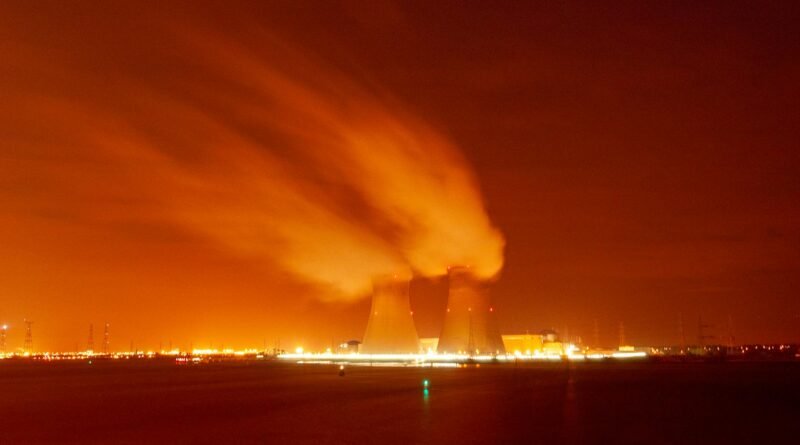
Deeply Concerned’: IAEA Chief Warns of Nuclear Catastrophe as Fourth Strike Hits Near Bushehr Plant, Killing Security Officer
VIENNA, Austria — The head of the United Nations nuclear watchdog issued an urgent warning Saturday after reports emerged of yet another projectile strike near Iran’s Bushehr nuclear power plant—the fourth such incident in recent weeks—which killed a member of the site’s physical protection staff and damaged a building on the premises.
Rafael Grossi, Director General of the International Atomic Energy Agency (IAEA), said he was “deeply concerned” by the escalating pattern of attacks in the immediate vicinity of the facility. The IAEA was informed of the strike by Iranian officials, who also reported that a security officer was killed by a projectile fragment and that a building on site was affected by shockwaves and fragments. No increase in radiation levels has been reported following the latest incident.
France Moves Closer to Social Media Ban for Under-15s as Senate Approves Conditional Restrictions.
“Nuclear power plant sites or nearby areas must never be attacked,” Grossi said in a statement from Vienna, emphasizing that auxiliary site buildings may contain vital safety equipment. The IAEA chief reiterated his call for “maximum military restraint” to avoid the risk of a nuclear accident, warning that the conflict in the Middle East is now edging dangerously close to a catastrophe that could dwarf anything seen so far.
A Pattern of Escalation: Four Strikes in Weeks
The attack on Saturday marks the fourth projectile strike in the vicinity of the Bushehr plant since the Middle East conflict entered its second month. The previous strike occurred on March 18, when a structure approximately 350 meters (roughly 380 yards) from the reactor was hit and destroyed. No damage to the reactor or injuries were reported in that incident, but the IAEA warned at the time that any attack near nuclear facilities risks violating key safety principles.
‘Priced Out of the Market’: UN Warns Developing Countries Trapped by Unfair Credit Ratings as Debt Costs Soar | ‘They Cannot Afford Another Fall’: Myanmar’s Fragile Recovery from Deadly Earthquake Undermined by Global Crises.
The Bushehr Nuclear Power Plant, located on Iran’s southern coast along the Persian Gulf, is the country’s first commercial nuclear reactor. It began operations in 2011 with assistance from Russia and remains under IAEA safeguards. While the plant has been designed to withstand significant external shocks—including earthquakes and, theoretically, some conventional attacks—the IAEA has repeatedly warned that no nuclear facility can be made invulnerable to direct or indirect military action.
Each successive strike inches closer to the reactor itself. The March 18 attack destroyed a structure hundreds of meters away. Saturday’s attack, according to Iranian officials, killed a security officer on site and caused damage from shockwaves and fragments. The trajectory—both literal and figurative—is deeply alarming.
The Seven Pillars: A Framework Under Threat
In his statement, Grossi reiterated the importance of adhering to the IAEA’s “Seven Indispensable Pillars” for ensuring nuclear safety and security during an armed conflict. These pillars, introduced by the IAEA chief in March 2022 at the outset of the war in Ukraine, were designed to address the unprecedented challenge of maintaining nuclear safety when facilities are located in active warzones.
The seven pillars are:
- The physical integrity of facilities—reactors, fuel ponds, and radioactive waste stores—must be maintained.
- All safety and security systems and equipment must be fully functional at all times.
- The operating staff must be able to fulfill their safety and security duties and have the capacity to make decisions free of undue pressure.
- There must be a secure off-site power supply from the grid for all nuclear sites.
- There must be uninterrupted logistical supply chains and transportation to and from the sites.
- There must be effective on-site and off-site radiation monitoring systems, and emergency preparedness and response measures.
- There must be reliable communication with the regulator and others.
The attacks near Bushehr, Grossi indicated, threaten multiple pillars simultaneously. The physical integrity of facilities is at risk. Off-site power supplies and logistical chains could be disrupted by wider conflict. And emergency preparedness measures are only as effective as the warning time available—warning time that may not exist if a direct hit occurs without notice.
“Any attack near nuclear facilities risks violating key safety principles,” the IAEA warned after the March 18 strike. Saturday’s incident, with its confirmed fatality and building damage, suggests those risks are materializing.
A Regional Nuclear Web: Beyond Bushehr
The danger is not confined to Bushehr. In an address to the IAEA Board at the agency’s headquarters in Vienna earlier this month, Grossi underscored the widening risk of a nuclear incident from the military escalation, noting that Iran “and many other countries in the region that have been subjected to military attacks have operational nuclear power plants and nuclear research reactors.”
While Bushehr is the only operating nuclear power plant in Iran, the country also operates several research reactors and nuclear facilities, including the Isfahan Uranium Conversion Facility, the Natanz and Fordow enrichment plants, and the Arak heavy water reactor. Each of these sites, if struck, could release radioactive material, with consequences extending far beyond Iran’s borders.
Moreover, the conflict has drawn in other nations with nuclear facilities. The United Arab Emirates operates the Barakah Nuclear Power Plant, the first nuclear facility in the Arab world, located just across the Persian Gulf. Israeli nuclear facilities at Dimona and elsewhere have also been the subject of speculative threats. A single miscalculation, a single stray projectile, could trigger a radiological release that would contaminate air, water, and soil across national boundaries.
The Human Toll: A Security Officer Killed
Amid the strategic warnings and technical discussions, Saturday’s attack had a human face: a member of the Bushehr site’s physical protection staff was killed by a projectile fragment. Iranian officials reported the death to the IAEA, though the individual’s name has not been publicly released.
The security officer was not a combatant in the broader Middle East conflict. He was a guard, tasked with protecting a nuclear facility from exactly the kind of attack that ultimately claimed his life. His death is a grim reminder that even “near misses” have consequences—and that the next projectile might not miss.
A History of Warnings
The IAEA’s concern about attacks near nuclear facilities is not new. In 2022, when Russian forces seized the Zaporizhzhia Nuclear Power Plant in Ukraine, Grossi warned repeatedly that the world was “playing with fire.” Shelling near the plant—the largest in Europe—prompted repeated emergency shutdowns and risked a nuclear catastrophe. The seven pillars were developed in direct response to the Zaporizhzhia crisis.
Now, those same pillars are being tested in the Middle East. Grossi has called for maximum military restraint from all parties, urging combatants to remember that nuclear accidents do not respect borders or allegiances. “The IAEA will continue to monitor the situation closely,” he said Saturday. “But monitoring alone cannot prevent a disaster. Only restraint can.”
What Happens Next?
The immediate aftermath of Saturday’s strike is, for now, one of relief: no increase in radiation levels has been reported. The reactor itself appears undamaged. But the pattern of repeated attacks—four in recent weeks, with the most recent causing a fatality and structural damage—suggests an escalating dynamic that may not stop on its own.
Iran has not publicly identified who was responsible for the strike, though given the ongoing conflict, suspicion will fall on either the United States or Israel, both of which have conducted military operations against Iranian targets in recent weeks. Regardless of attribution, Grossi’s message is addressed to all parties: nuclear sites are off-limits. There is no such thing as a “limited” strike near a nuclear reactor.
The IAEA chief has called for an immediate de-escalation and for all combatants to recommit to the principle that nuclear facilities must never be targeted—directly or indirectly. “The risk of a nuclear accident is real,” Grossi said. “And it is growing with each passing day.”
For the people living near Bushehr, for the security officers guarding the plant, and for the millions across the region who would be affected by a radiological release, the hope is that Grossi’s warning will be heard before it is too late.
SOURCES / INPUTS
https://news.un.org/en/story/2026/04/1167250
Modern World Order Explained: Power, Alliances & Global Systems.
Indonesia Receives Bodies of Peacekeepers Killed in Lebanon, Holds Solemn Repatriation Ceremony | Iran Warns of Radioactive Contamination Risk After Strikes on Bushehr Nuclear Plant.