Planetary Warning: UN Agency Flags Record ‘Climate Imbalance’ as Earth Accelerates Toward Chaos
GENEVA, Switzerland — The Earth is no longer simply warming. It is tipping into a state of profound and accelerating “climate imbalance”—a condition where the fundamental physics of the planet are shifting in ways that scientists say have no parallel in observed history. According to the World Meteorological Organization’s (WMO) State of the Global Climate report for 2025, released Monday, greenhouse gases have reached all-time highs, ocean heat has shattered records for the ninth consecutive year, and the planet is trapping energy at a rate that signals a dangerous new era of instability.
Between 2015 and 2025, the world experienced the 11 hottest years ever recorded. The year 2025 alone registered a global temperature anomaly of 1.43°C above pre-industrial levels—a stark reminder that the Paris Agreement’s aspirational goal of limiting warming to 1.5°C is slipping further out of reach with each passing year. But temperature anomalies, while alarming, tell only part of the story. For the first time, the WMO has placed a spotlight on a deeper, more consequential metric: the Earth’s energy imbalance.
OnePlus India CEO Robin Liu Quits as Market Share Plummets, Fueling Exit Speculation.
“Our planet is absorbing more solar energy than it radiates back into space,” said Ko Barrett, WMO Deputy Secretary-General, in a briefing to reporters in Geneva. “This excess energy is not just warming the surface. Ninety percent of it is being stored in our oceans. The result is a planetary system that is increasingly out of balance—with consequences that will reverberate for generations.”
The Energy Imbalance: A Planet Out of Sync
The concept of Earth’s energy imbalance is deceptively simple. In a stable climate, the amount of energy the planet receives from the sun is roughly equal to the amount it radiates back into space. Greenhouse gases—carbon dioxide (CO₂), methane, and nitrous oxide—trap outgoing infrared radiation, disrupting this equilibrium. The more greenhouse gases accumulate, the greater the imbalance.
The WMO’s 2025 report reveals that this imbalance has more than doubled since 2005. In 2025, it recorded its largest annual spike yet. The implications are staggering: the excess heat being absorbed by the Earth system is equivalent to detonating dozens of Hiroshima-sized atomic bombs every second, year after year.
Where does all that energy go? The breakdown is sobering:
- 91 percent is absorbed by the oceans, driving marine heatwaves, coral bleaching, and acidification.
- 3 percent goes into melting land ice, from Greenland and Antarctica to mountain glaciers.
- Only 1 percent directly warms the atmosphere, yet that single percentage point is enough to fuel extreme weather events of unprecedented ferocity.
“The Earth system is more out of balance than anything we have observed in the modern record,” explained John Kennedy, a WMO scientist who contributed to the report. “This isn’t a gradual shift anymore. It’s an acceleration.”
Oceans on Fire: Heat Content Shatters Every Record
For the ninth consecutive year, ocean heat content—the total energy stored in the upper layers of the sea—set a new record in 2025. The oceans absorbed an estimated 23 zettajoules of heat, a figure so vast it defies easy comprehension. This relentless accumulation of energy is reshaping marine ecosystems and threatening the livelihoods of more than 3 billion people who depend on the sea for food and income.
Marine heatwaves are becoming more frequent and intense. Coral reefs, often called the rainforests of the sea, are experiencing mass bleaching events on a near-annual basis. The Great Barrier Reef, already battered by repeated bleaching, saw another severe event in 2025. Meanwhile, ocean acidification—caused by the absorption of excess CO₂—is accelerating, threatening shellfish, plankton, and the entire marine food web.
The consequences extend far beyond the water. Warm oceans provide the fuel for tropical cyclones, turning storms into monstrous, rapidly intensifying systems that defy forecasting models. In 2025, several cyclones underwent “explosive intensification,” catching communities off guard and causing catastrophic damage across the Pacific and Indian Ocean basins.
Glaciers, Ice Sheets, and the Rising Seas
The WMO report paints a bleak picture of the cryosphere—the frozen parts of the planet. Glaciers from the Himalayas to the Andes are melting at rates not seen in millennia. The Greenland and Antarctic ice sheets are losing mass at an accelerating pace, contributing to a rise in global sea levels that now exceeds any three-decade period in the last century.
Sea level rise is no longer a distant threat. It is a present reality for the 11 percent of humanity living on low-lying coasts. From Miami to Mumbai, from Shanghai to Lagos, cities are experiencing more frequent high-tide flooding—so-called “nuisance flooding”—that is becoming a chronic disruption. In small island developing states like Tuvalu and the Marshall Islands, the very existence of their nations is at stake.
Philippines Declares National Energy Emergency as Middle East Crisis Threatens Fuel Supply Seven-Ton Meteor Streaks Across Cleveland Sky, Startling Residents Across Multiple States.
The WMO’s Barrett put it bluntly: “What happens in the Arctic doesn’t stay in the Arctic. The melting of polar ice is driving sea level rise that threatens hundreds of millions of people. And once ice melts, it doesn’t come back—at least not on any timescale that matters to human civilization.”
Greenhouse Gases: The Unrelenting Rise
The root cause of this planetary imbalance remains the unabated emission of greenhouse gases. Atmospheric concentrations of CO₂, methane, and nitrous oxide reached record highs in 2024—the latest year for which complete global data is available—and preliminary figures for 2025 show continued increases.
Methane, a particularly potent greenhouse gas, rebounded sharply, rising by 1.03 percent to reach 412.59 megatons, surpassing peaks recorded in 2023. Total greenhouse gas emissions in 2024 reached 60.63 gigatons of CO₂ equivalent—a figure that puts the world far off track from any pathway that would limit warming to 1.5°C or even 2°C.
“Every fraction of a degree matters,” the report emphasizes. “But every ton of CO₂ emitted locks in warming for millennia. The choices we make this decade will determine the climate future for hundreds of generations.”
Extreme Weather: The Human Toll
Behind the numbers are human lives upended. The year 2025 was defined by extremes that stretched from the Arctic to the Sahara. Record-breaking heatwaves scorched Europe and North America, with temperatures in parts of Spain and Italy exceeding 48°C (118°F). Wildfires raged across Canada, Brazil’s Pantanal wetlands, and Greece, burning millions of hectares and blanketing cities in toxic smoke.
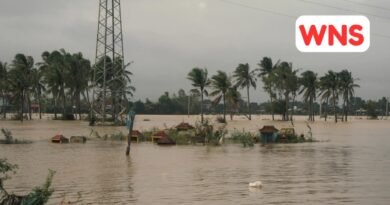
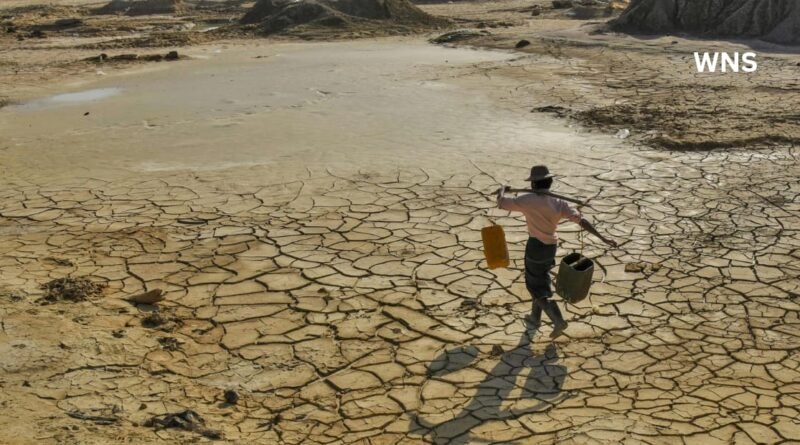
Flooding claimed thousands of lives across West and Central Africa, where the Niger and Congo rivers overflowed their banks. In the Horn of Africa, a prolonged drought followed by intense flash floods created a cycle of displacement and disease. Typhoons in Southeast Asia grew more powerful and erratic, overwhelming infrastructure that was never designed to withstand such forces.
The WMO notes that while extreme weather events are increasing in frequency and intensity, they are not inevitable disasters. The gap between a weather event and a humanitarian catastrophe is often the presence—or absence—of an effective early warning system.
Early Warnings: A Lifeline Amid Chaos
The WMO has made Early Warnings for All (EW4All) a signature initiative, co-led with the UN Office for Disaster Risk Reduction (UNDRR). The goal is ambitious: to ensure that every person on Earth is protected by early warning systems within the next few years. Currently, roughly 70 percent of nations—primarily in Africa, South Asia, and the Pacific—lack adequate coverage.
The case for investment is overwhelming. Early warnings can reduce disaster-related deaths by a factor of six, according to WMO data. They provide a return on investment of at least 10 to 1 in terms of lives saved and economic losses averted. Yet funding for such systems remains a fraction of what is needed.
“Early warnings are not a luxury,” Barrett emphasized. “They are a lifesaving necessity. We have the technology, the science, and the know-how. What we lack is the political will to scale them to the communities that need them most.”

The urgency of this message was underscored by extreme events already unfolding in 2026. Early in the year, Arctic blasts disrupted energy grids across the southern United States, while unprecedented wildfires in South America’s Pantanal region—the world’s largest tropical wetland—signaled that the climate emergency has not paused for diplomatic deliberation.
The Path Ahead: From Imbalance to Resilience?
The WMO has been publishing its State of the Global Climate report for more than 30 years. Each edition has documented a planet under increasing stress. But the 2025 report is different. It marks the first time the agency has formally tracked and highlighted Earth’s energy imbalance as a core metric—a recognition that surface temperature alone no longer captures the magnitude of the crisis.
What makes the situation particularly dire is the irreversibility of many trends. The heat already stored in the oceans will continue to drive sea level rise for centuries, regardless of future emission cuts. The glaciers lost this year will not return in any timeframe that matters to human civilization. The species pushed to extinction by rising temperatures are gone forever.
Yet the report is not without a sliver of agency. The choices made in the coming years will determine whether the imbalance stabilizes or accelerates further. Rapid, deep emissions cuts remain the only pathway to a livable future. Alongside mitigation, adaptation—including resilient infrastructure, climate-smart agriculture, and universal early warnings—can protect billions from the worst impacts.
As António Guterres, UN Secretary-General, framed it in his response to the report: “Planet Earth is being pushed beyond its limits. But we are not helpless. The science is clear. The tools exist. What we need is the courage to act—and the urgency that this moment demands.”
Looking Ahead: 2026 and Beyond
As the world moves through 2026, the climate crisis is no longer a future threat—it is a present reality. The WMO’s report is a document of record, but it is also a warning. The window to avert the most catastrophic outcomes is closing. For the billions of people already living with the consequences of a planet out of balance, the time for half-measures has passed.
The data is unequivocal. The energy imbalance is accelerating. The oceans are record-hot. The ice is vanishing. And the greenhouse gases that drive it all continue to rise.
“Delay is deadly,” the report concludes. “The science demands action. The people demand action. And the planet—our only home—demands action.”
SOURCES / INPUTS
UN News: UN weather agency warns of record ‘climate imbalance’
https://news.un.org/en/story/2026/03/1167178
Climate Change Explained: Science, Global Policy, Economic Impact & Sustainability Strategy.
7.6 Magnitude Earthquake Strikes Near Tonga, Prompting Coastal Evacuations but No Tsunami Threat, El Niño Forecast 2026: Scientists Predict Shift from La Niña with Potential for ‘Super El Niño’.