‘A New Era of Cosmic Surveys’: NASA to Unveil Complete Roman Space Telescope Ahead of Fall Launch
GREENBELT, Maryland — After years of meticulous design, assembly, and testing, NASA’s next flagship astrophysics mission—the Nancy Grace Roman Space Telescope—has reached a historic milestone. The agency announced Thursday that the telescope is fully constructed, has completed its final integration, and is now wrapping up prelaunch testing before a planned launch as early as this fall.
Media and the public will get their final Earth-bound glimpse of the $3.9 billion observatory on Tuesday, April 21, when NASA hosts an unveiling event at the agency’s Goddard Space Flight Center in Maryland. The event will take place in Goddard’s largest clean room—the same facility where the Hubble Space Telescope was assembled decades ago—and will feature a news conference streaming live on NASA’s YouTube channel at 4 p.m. EDT.
Global Markets Rebound as US-Iran Ceasefire Hopes Drive Oil Below $100, Gold Surges.
“The Roman Space Telescope represents the next great leap in our understanding of the cosmos,” said NASA Administrator Jared Isaacman, who will be among the speakers at the April 21 briefing. “With its unprecedented wide-field view and cutting-edge technology, Roman will unveil troves of celestial objects and help us answer some of the deepest questions about our universe—including whether life exists on other worlds.”
A Telescope Named for a Visionary
The Nancy Grace Roman Space Telescope—often called the “mother of Hubble” for her pioneering role in championing large space telescopes—is named after NASA’s first chief astronomer. Dr. Roman, who died in 2018 at the age of 93, was instrumental in convincing Congress and the scientific community to fund what would become the Hubble Space Telescope. Now, a generation later, the mission that bears her name is poised to surpass even Hubble’s revolutionary impact.
While Hubble and the James Webb Space Telescope are designed to peer deep into narrow fields of view with extraordinary sensitivity, Roman is built to do the opposite: capture panoramic, wide-field images of the cosmos with staggering resolution. Its primary instrument, the Wide Field Instrument, will have a field of view 100 times larger than Hubble’s infrared camera, allowing Roman to map vast swaths of the sky in a fraction of the time.
“Roman will give us a deep, panoramic view of the universe that we’ve never had before,” said Nicky Fox, associate administrator for NASA’s Science Mission Directorate, who will also speak at the unveiling. “It’s like switching from a telephoto lens to a wide-angle lens—except both have the sharpness of Hubble. The discoveries Roman will enable are almost impossible to predict, and that’s the most exciting part.”
Unlocking the Universe’s Deepest Mysteries
The Roman Space Telescope is designed to tackle three overarching scientific goals that cut to the heart of modern astrophysics:
1. Unraveling Dark Energy and Dark Matter
Roman will conduct a massive, multi-year survey of the cosmos to probe the nature of dark energy—the mysterious force accelerating the expansion of the universe. By measuring the positions and distances of hundreds of millions of galaxies, Roman will create the largest 3D map of the universe ever attempted, offering new insights into how cosmic structure has evolved over billions of years.
2. Discovering Exoplanets Through Microlensing
Roman will carry out a pioneering survey to detect exoplanets using a technique called gravitational microlensing. Unlike Kepler and TESS, which find planets by detecting faint dips in starlight as planets transit their host stars, Roman will watch for the subtle brightening that occurs when a planet’s gravity bends and magnifies light from a distant star. This method will allow Roman to find thousands of new worlds, including rogue planets—planets that wander through space untethered to any star.
3. Directly Imaging Nearby Exoplanets
Perhaps most ambitiously, Roman will demonstrate a technology that could one day lead to the first direct images of Earth-like planets around Sun-like stars. The mission’s Coronagraph Instrument, a technology demonstration developed with contributions from the European Space Agency (ESA) and the Japan Aerospace Exploration Agency (JAXA), will test advanced starlight-blocking techniques that are orders of magnitude more sensitive than any previously flown.
“The Roman Coronagraph will be the most advanced technology ever flown in space to directly image planets around nearby stars,” said Julie McEnery, Roman senior project scientist at NASA Goddard, who will participate in the April 21 briefing. “It’s a critical stepping stone toward the Habitable Worlds Observatory, a future mission concept designed to find and characterize planets that could harbor life.”
A Flagship Years in the Making
The Roman Space Telescope’s journey to completion has been years in the making. Originally conceived in the 2010s as the Wide Field Infrared Survey Telescope (WFIRST), the mission underwent multiple redesigns and budget reviews before being renamed in honor of Nancy Grace Roman in 2020. The telescope’s primary mirror is the same size as Hubble’s—2.4 meters (7.9 feet)—but Roman’s instruments are designed to achieve far broader coverage.
Philippines Declares National Energy Emergency as Middle East Crisis Threatens Fuel Supply ‘Summer in Spring’: NASA Reports Record March Heat Wave Scorches Southwest.
The telescope was assembled at NASA Goddard, with significant contributions from the agency’s Jet Propulsion Laboratory in Southern California, Caltech/IPAC in Pasadena, and the Space Telescope Science Institute in Baltimore. Primary industrial partners include BAE Systems (Boulder, Colorado), L3Harris Technologies (Rochester, New York), and Teledyne Scientific & Imaging (Thousand Oaks, California).
International partners have also played a vital role. ESA is providing the Coronagraph Instrument’s optical bench and other components. JAXA is contributing advanced detector technology. The French space agency CNES and Germany’s Max Planck Institute for Astronomy are also participating in the mission.
The Final Countdown: Launch and Beyond
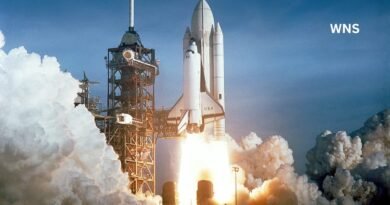
With construction now complete and prelaunch testing in its final phase, Roman will soon ship from Goddard to NASA’s Kennedy Space Center in Florida, where it will undergo final preparations for launch. The telescope is scheduled to lift off atop a SpaceX Falcon Heavy rocket as early as October 2026, with a launch window extending into November.
Once in orbit, Roman will travel to the Sun-Earth Lagrange Point 2—the same gravitational balance point where James Webb currently operates, about 1 million miles from Earth. From that vantage point, Roman will begin its five-year primary mission, scanning the skies with an efficiency that will make it the preeminent survey telescope of its generation.
“This is an incredibly exciting time for the Roman team and for the entire astrophysics community,” said Jamie Dunn, Roman telescope project manager at NASA Goddard, who will also speak at the April 21 briefing. “After years of hard work, we’re finally seeing this mission come together. The telescope is complete. The instruments are performing beautifully. And we are on track to deliver the science that Nancy Grace Roman dreamed of.”
A Broader Look: NASA’s Cosmic Vision
The April 21 unveiling at Goddard is not just about Roman. Credentialed media attending the event will also have the opportunity to tour other center facilities and interview subject matter experts on a range of NASA’s most ambitious missions, including:
- The DAVINCI mission to Venus, which will plunge through the planet’s hostile atmosphere to study its composition and history.
- The Dragonfly mission to Saturn’s moon Titan, a nuclear-powered rotorcraft designed to explore the methane-rich surface of this ocean world.
- A candidate payload for the Artemis program—the Lunar Environment Monitoring Station, which would study the Moon’s surface environment to prepare for long-term human presence.
- The Habitable Worlds Observatory mission concept, a future flagship telescope designed specifically to find and study potentially life-bearing planets beyond our solar system.
The event underscores the breadth of NASA’s astrophysics and planetary science portfolio at a moment when the agency is balancing flagship missions like Roman with the demands of Artemis lunar exploration and the ongoing operations of Hubble, Webb, and dozens of other missions.
A New Era Dawns
For astronomers and space enthusiasts alike, the unveiling of the complete Roman Space Telescope marks the beginning of a new era. With its unparalleled ability to survey the cosmos, its cutting-edge exoplanet imaging technology, and its potential to unlock the mysteries of dark energy and dark matter, Roman is poised to deliver a decade of transformative discoveries.
As the telescope prepares to leave the clean room where it was assembled, it carries with it the legacy of the woman who fought to make space-based astronomy a national priority—and the promise of answers to questions we have yet to ask.
“Nancy Grace Roman once said that she wanted to know what was out there,” Administrator Isaacman reflected. “Thanks to her vision and the dedication of thousands of scientists, engineers, and technicians, we’re about to find out.”

SOURCES / INPUTS
Global Education Systems Explained: Access, Research & Innovation.
NASA Confirms Artemis II Mission on Track for April 1 Launch After Final Preparations, Seven-Ton Meteor Streaks Across Cleveland Sky, Startling Residents Across Multiple States.