Iran Hits Gulf Energy Facilities After Israeli Strike on South Pars Gas Field, Escalating Regional War
Missiles set Qatari LNG complex ablaze, damage UAE and Saudi infrastructure as Trump warns Tehran against further attacks
DUBAI — March 19, 2026 — Iran launched waves of missile strikes targeting major energy facilities across the Gulf on Wednesday and early Thursday, retaliating for an Israeli attack on its massive South Pars natural gas field in a dramatic escalation that has set global energy markets ablaze and drawn the United States deeper into the widening regional conflict .
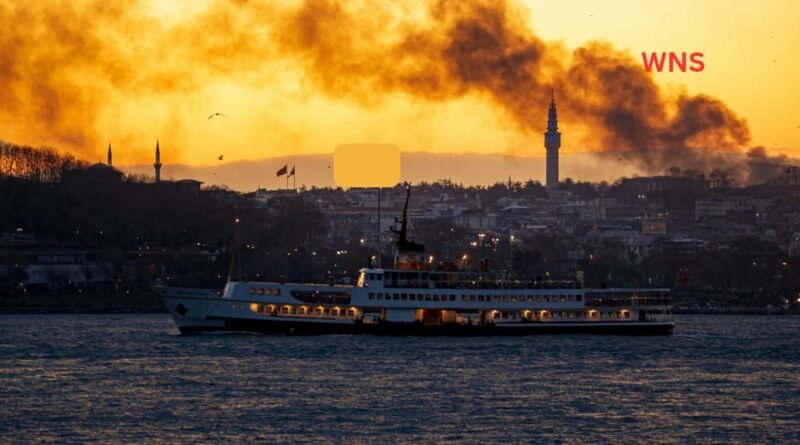
The Islamic Revolutionary Guard Corps (IRGC) claimed responsibility for the attacks, which caused extensive damage to Qatar’s Ras Laffan Industrial City—the world’s largest liquefied natural gas (LNG) production hub—as well as facilities in Saudi Arabia and the United Arab Emirates . A ship was set ablaze off the UAE coast and another damaged near Qatar, underscoring the danger facing vessels in the Persian Gulf as Iran tightens its stranglehold on the Strait of Hormuz .
Sri Lanka Reintroduces QR Code Fuel Rationing System Amid Middle East Supply Disruption.
QatarEnergy confirmed that missile strikes on Ras Laffan sparked “sizeable fires and extensive further damage” to several LNG facilities, though civil defense teams brought all blazes under control without reported injuries . The Abu Dhabi Media Office announced that operations at the Habshan gas facility and Bab field had been halted after debris from intercepted missiles fell on the sites .
South Pars Attack Triggers Retaliation
The Iranian retaliation followed what Tehran described as an Israeli airstrike on its South Pars gas field in the southern Bushehr province on Wednesday. The attack targeted gas storage tanks at Asaluyeh, halting production at two refineries with a combined capacity of approximately 100 million cubic meters per day .
Israel has not publicly claimed responsibility for the strike on the offshore field, which Iran shares with Qatar across the Persian Gulf. However, according to the Wall Street Journal and Axios, U.S. President Donald Trump knew of Israel’s plan in advance and supported it .
In a lengthy post on his Truth Social platform Wednesday night, Trump confirmed that Israel carried out the attack but distanced the United States from involvement. “The United States knew nothing about this particular attack, and the country of Qatar was in no way, shape, or form, involved with it, nor did it have any idea that it was going to happen,” Trump wrote .
The president warned that Israel would not strike South Pars again, but issued a stark ultimatum to Tehran: “NO MORE ATTACKS WILL BE MADE BY ISRAEL pertaining to this extremely important and valuable South Pars Field unless Iran unwisely decides to attack a very innocent, in this case, Qatar – In which instance the United States of America, with or without the help or consent of Israel, will massively blow up the entirety of the South Pars Gas Field at an amount of strength and power that Iran has never seen or witnessed before” .
Warnings and Wider Strikes
Hours before launching the attacks, the IRGC issued an “urgent warning” through Iran’s semi-official Tasnim news agency, listing multiple Gulf energy facilities it described as “direct and legitimate targets” and calling on civilians and workers to evacuate immediately . The list included Saudi Arabia’s SAMREF refinery and Jubail petrochemical complex, the UAE’s Al Hosn gas field, and Qatar’s Mesaieed petrochemical complex and Ras Laffan refinery .
Iran subsequently fired missiles at Saudi Arabia’s Eastern Province, home to many of its oil fields, as well as Kuwait and Bahrain . Saudi authorities reported intercepting four ballistic missiles launched toward Riyadh and thwarting a drone attack on a gas facility in the east . Missile alert sirens sounded across multiple Gulf locations .
Regional Condemnation and Diplomatic Fallout
Qatar’s foreign ministry rebuked Israel for a “dangerous and irresponsible” attack on Iran’s South Pars facilities and condemned Iran for what it called “a flagrant breach” of international law, expelling two senior Iranian diplomats . Doha’s state oil company reported that the missile strike on Ras Laffan caused extensive damage to a gas-to-liquids facility and multiple LNG installations .
Saudi Foreign Minister Prince Faisal bin Farhan delivered a stern warning after the attacks on the kingdom. “What little trust there was before has completely been shattered,” he said. “The attacks on my country and on neighboring countries that are not involved in this conflict are my main concern. We will use every lever at our disposal—political, economic, diplomatic, and otherwise—to bring these attacks to a halt” .
Prince Faisal added that Saudi Arabia “reserves the right to take military actions, if deemed necessary, and if the time comes, the leadership of the Kingdom will take the necessary decision. We will not shy away from protecting our country and our economic resources” .
Russia Accuses Ukraine of ‘Reckless’ Drone Strikes on TurkStream Gas Pipeline Supplying Europe Seven-Ton Meteor Streaks Across Cleveland Sky, Startling Residents Across Multiple States.
Foreign ministers of 12 Arab and Islamic states issued a joint statement urging Iran to “immediately” halt attacks on residential areas and civilian infrastructure, including oil facilities, desalination plants, airports, and diplomatic premises .
Global Energy Markets Reel
The escalating attacks on energy infrastructure have sent shockwaves through global markets. Brent crude oil, the international benchmark, surged above $110 per barrel in morning trading Thursday, up more than 50% since the U.S. and Israel launched strikes on Iran on February 28 . U.S. diesel prices have already risen above $5 a gallon for the first time since 2022 .
The disruption of shipping through the Strait of Hormuz, which normally handles approximately one-fifth of the world’s oil and LNG supply, has forced production cuts estimated at up to 10% of global demand . Iran insists the waterway remains open but not to U.S. or allied vessels, allowing only a trickle of traffic .
Pacific nations heavily reliant on imported fuel, including Samoa and Tonga, have appealed for help amid fears of shortages and escalating costs . In Gulf supermarkets, food prices are rising as the blockade drives up import costs, with meat prices nearly doubling in some Bahraini stores .
Wider Conflict Intensifies
The energy strikes came as Israel continued its campaign to decimate Iran’s leadership. Israeli forces killed Iran’s intelligence chief Esmail Khatib on Wednesday, a day after assassinating powerful security council head Ali Larijani . Israeli Defence Minister Israel Katz declared that “no one in Iran has immunity and everyone is in the crosshairs” .
Iranian missile attacks have killed at least 15 people in Israel since the war began, including a foreign worker in central Israel early Thursday . Falling shrapnel from Iranian missiles also struck a hair salon in the West Bank town of Beit Awa near Hebron late Wednesday, killing three Palestinian women—the first Palestinian deaths from Iranian attacks in the conflict .
In Lebanon, Israeli airstrikes destroyed apartment buildings in central Beirut, the most intense bombardment of the capital since the 2024 war, as fighting with Iran-backed Hezbollah intensified . Lebanese authorities report more than 900 people killed and over 800,000 displaced since the country was drawn into the conflict on March 2 .
International Calls for Restraint
French President Emmanuel Macron said he spoke with Trump and the Emir of Qatar, calling for a “moratorium on strikes targeting civilian infrastructure,” especially water and energy facilities. “Civilian populations and their essential needs, as well as the security of energy supplies, must be preserved from military escalation,” he posted on social media .
European Union foreign policy chief Kaja Kallas spoke by phone with Iranian Foreign Minister Abbas Araghchi, emphasizing that safe passage through the Strait of Hormuz is a priority for Europe and that the EU supports a diplomatic solution .
As the war enters its 20th day with no end in sight, the targeting of critical energy infrastructure marks a perilous new phase. Damage to Qatar’s LNG facilities could delay supplies to global markets even after the conflict ends , while Iran’s supreme leader Mojtaba Khamenei vowed in a written message that “every drop of spilled blood comes at a price” .

SOURCES / INPUTS
Anadolu Ajansı: Iran warns of imminent strikes on major oil, gas facilities in Gulf countries
Khaleej Times: ‘No more Israeli attacks’: Trump denies involvement in striking Iran gas field
The New Arab: Iran gas field bombed, Tehran attacks Gulf energy facilities
Modern World Order Explained: Power, Alliances & Global Systems.
Hong Kong Begins Evidence Hearings Into Deadly 2025 Fire That Killed 168, Citing Discarded Cigarette as Likely Cause, Nigerian Forces Repel Multiple Insurgent Attacks Across Northeast, Killing Scores of Fighters.