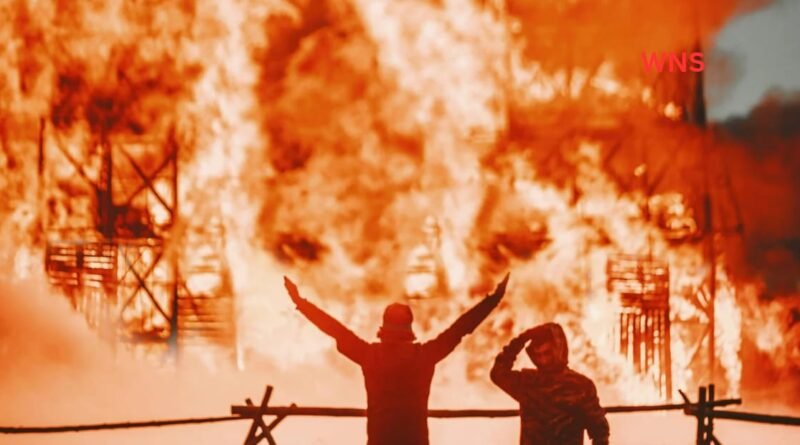
Hong Kong Begins Evidence Hearings Into Deadly 2025 Fire That Killed 168, Citing Discarded Cigarette as Likely Cause
Independent committee hears of ‘multiple overlapping failures’ as inquiry opens into world’s deadliest residential blaze since 1980
HONG KONG — March 19, 2026 — An independent committee investigating a catastrophic fire that ripped through a Hong Kong housing complex last November, killing 168 people, opened its first public evidential hearings on Thursday, with lawyers presenting evidence pointing to a discarded cigarette as the most likely ignition source amid a cascade of systemic safety failures .
The blaze at Wang Fuk Court in the Tai Po district on November 26, 2025, engulfed seven of the eight residential towers, which were undergoing major renovation works. It stands as the world’s deadliest residential building fire since 1980 and Hong Kong’s most lethal since 1948, burning for over 43 hours and displacing more than 4,000 residents .
Sri Lanka Reintroduces QR Code Fuel Rationing System Amid Middle East Supply Disruption.
The judge-led committee, chaired by High Court Justice David Lok Kai-hong, commenced its first round of eight hearings scheduled to run until April 2 at the City Gallery in Central. Approximately 360 public seats are available per session, with half reserved for residents of the affected estate .
Evidence Points to Cigarette Butt in Light Well
In his opening address, Victor Dawes, the lead barrister for the independent committee, stated that all evidence indicates the fire originated at a light well outside units 104 and 105 of Wang Cheong House . Surveillance footage showed debris falling from the rear of the building at around 2:33 p.m., followed by small flashes suspected to be burning embers appearing approximately ten minutes later .
Crucially, footage from a contractor-installed camera on the fifth-floor scaffolding captured workers at approximately 2:42 p.m. exclaiming, “Who is smoking?” followed by shouts of “Fire! The scaffolding is on fire!” moments before large flames erupted . The first call to police was made by a bystander at 2:50 p.m., with video evidence showing no fire alarms activated despite the fire having already spread across multiple storeys .
Dawes cited preliminary analysis from the government’s cross-departmental investigation panel indicating that ignition of flammable materials littered in the light well—including charred cardboard, gloves, plastic bottles, and other combustibles—by a discarded cigarette is the primary suspected cause . Investigators have reportedly ruled out electrical faults, gas leaks, sparks from construction work, or intentional arson .
Notably, a photograph presented at the hearing showed a worker smoking on the rooftop of the same building at 2:43 p.m. on the day of the fire, supporting the theory that a discarded cigarette butt ignited nearby cardboard boxes . Dawes emphasized that while there is no direct evidence identifying the specific individual responsible, the presence of numerous cigarette butts at the suspected origin point and repeated resident complaints about workers smoking on scaffolding that went unaddressed point to a pattern of negligence .
“We may never know with 100 percent certainty the exact cause, but the circumstantial evidence points strongly to a lit cigarette as the most probable ignition source,” Dawes told the hearing .
‘Multiple Overlapping Failures’ Led to Catastrophe
Dawes described the tragedy as resulting from “multiple overlapping failures” where almost all fire safety systems were rendered ineffective due to human factors . He outlined five critical deficiencies:
- Disabled Fire Alarm Systems: In seven of the eight blocks, fire alarm systems had been switched off, depriving residents of early warning and critical evacuation time .
- Removed Stairwell Windows: Windows in stairwells and corridors had been removed to create access points for workers, allowing thick smoke and flames to enter primary escape routes and trap residents .
- Disabled Fire Hydrants: Fire hydrant and hose reel systems had been deactivated. Although regulations prohibit disabling such systems for more than 14 days, contractors had repeatedly applied for extensions, leaving them non-operational for months .
- Combustible Materials on Scaffolding: Scaffolding platforms contained large quantities of combustible materials. Critically, fire-retardant mesh originally installed was replaced with non-fire-retardant mesh after a typhoon, and many residents’ windows were covered with foam panels, facilitating the rapid spread of flames into individual flats .
- Unaddressed Smoking Complaints: As previously noted, numerous complaints from residents about workers smoking on the scaffolding were allegedly ignored .
Dawes stressed that the fire’s rapid spread and the massive casualty count were the direct consequence of these preventable failures .
Victims and Devastation
The hearing provided the most detailed accounting of the human toll to date. Of the 168 deceased:
- 150 were residents of Wang Fuk Court .
- 9 were foreign domestic helpers .
- 7 were construction or renovation workers .
- 1 was a visitor .
- 1 was a firefighter, 37-year-old Ho Wai-ho, whose final movements were also detailed during the hearing .
Thirty-seven families lost two or more members, including parents and children, siblings, and other relatives. The victims ranged in age from six months to 98 years, with 114 individuals aged 65 or older and seven under 18 .
Russia Accuses Ukraine of ‘Reckless’ Drone Strikes on TurkStream Gas Pipeline Supplying Europe Seven-Ton Meteor Streaks Across Cleveland Sky, Startling Residents Across Multiple States.
The majority of deaths and injuries occurred in Wang Cheong House (81 dead, 33 injured) and Wang Tai House (82 dead, 14 injured), with many victims found within their units or in stairwells . The fire severely damaged 63 percent of units in Wang Cheong House and approximately 58 percent in Wang Tai and Wang San Houses .
Dawes pointed out that while approximately 150 households escaped via stairs and 250 used elevators, 900 households were empty at the time of the afternoon blaze, warning that the consequences could have been far worse had it occurred at night .
Committee’s Mandate and Scope
Justice Lok acknowledged the immense public expectation to find “an answer” after the tragedy, pledging a “thorough investigation” . He described the probe as “broad and complex,” noting that the committee has already gathered over one million documents, photos, and videos, totaling more than one terabyte of data .
The committee’s terms of reference, established by Chief Executive John Lee in December 2025, include:
- Investigating the cause of the fire and the reasons for its rapid spread .
- Examining the effectiveness and oversight of fire safety devices and equipment .
- Reviewing safety standards, materials, supervision, and maintenance related to building renovation works .
- Investigating potential systemic problems such as conflicts of interest, improper collusion, bid-rigging, corruption, or irregularities in the tendering process .
- Assessing the adequacy of current laws and penalties, and proposing improvements .
Thirty-eight stakeholders have been admitted as interested parties to the hearings, including multiple government departments (Buildings Department, Fire Services Department, Housing Department, Labour Department, etc.), seven Wang Fuk Court residents, members of the estate’s former owners’ corporation, and representatives from the architectural consultant and main contractor involved in the renovation project .
Ongoing Criminal Investigations
Parallel to the independent inquiry, police are conducting a criminal investigation and have arrested 38 individuals on suspicion of manslaughter, and a further six on suspicion of fraud related to the renovation project .
Hong Kong’s anti-graft watchdog, the Independent Commission Against Corruption (ICAC), has also arrested 23 people, including consultants, contractors, sub-contractors, members of the owners’ corporation, property management company staff, and intermediaries. They are suspected of offenses including bribery, conspiracy to defraud, and money laundering .
Residents Seek Answers and Accountability
Outside the hearing venue, residents expressed their hopes and grief. Seneca Lee, a former resident of Wang Tai House, told reporters she wanted to understand “the causes of the disaster and the responsibility,” stating she believed it was “not caused by just one or two factors” . She emphasized the need to determine who was responsible, whether through indirect or direct negligence, “to give the deceased justice” .
A 69-year-old man identified only as Law, who lived in Wang Fuk Court for over 30 years and lost a relative in the fire, expressed his anguish: “The thing I most want to know is why the fire alarms did not sound. They did not sound throughout the whole estate. That doesn’t make any sense” .
Yip Ka-kui, another former resident who lost his wife and home, said he wanted “justice for the deceased and an explanation for the victims,” insisting that those at fault “should take responsibility” .

The independent committee is required to submit its final report to the Chief Executive within nine months of its formation . The first round of hearings continues until April 2.
SOURCES / INPUTS
China Daily: Independent committee probing Hong Kong’s Tai Po fire holds 1st public hearing
The Standard (HK): Judge Lok pledges thorough probe as Wang Fuk Court fire hearings begins
Malay Mail/AFP: Hong Kong fire inquiry begins public hearings into blaze that killed 168
China Daily HK: Independent committee holds first evidential hearing on Tai Po fire
Modern World Order Explained: Power, Alliances & Global Systems.
Nigerian Forces Repel Multiple Insurgent Attacks Across Northeast, Killing Scores of Fighters, Iran Hits Gulf Energy Facilities After Israeli Strike on South Pars Gas Field, Escalating Regional War.