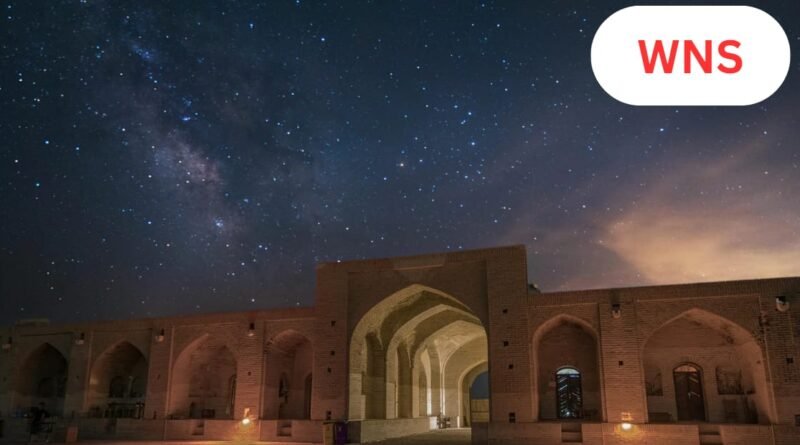
At least 56 cultural properties damaged across multiple provinces, including several UNESCO World Heritage sites, as war enters third week
TEHRAN — March 14, 2026 — Iran’s Ministry of Cultural Heritage, Tourism and Handicrafts announced on Saturday that at least 56 museums, historical sites, and cultural landmarks across the country have sustained damage during the ongoing conflict with the United States and Israel, with Tehran province recording the highest number of affected monuments .
The announcement comes as the Middle East war enters its 15th day, with cultural officials warning that several UNESCO World Heritage sites—including the lavish Golestan Palace in Tehran and the seventeenth-century Chehel Sotoun palace in Isfahan—have suffered significant structural damage from airstrikes and missile attacks .
Global markets steady after oil price plunge as Middle East conflict fuels volatility.
According to ministry data, Tehran province recorded 19 damaged sites, the highest of any region, followed by Kurdistan province with 12 important historical locations affected . In the southern port province of Bushehr, several century-old houses in the historic Siraf port district were hit, damaging buildings that date back two hundred years .
UNESCO-Verified Damage to World Heritage Properties
The United Nations Educational, Scientific and Cultural Organization (UNESCO) confirmed that it has verified damage to at least four of Iran’s 29 World Heritage sites since the conflict began on February 28 . The agency expressed deep concern about the fate of cultural properties across the region, noting that historic sites in Iran, Israel, and Lebanon have already been damaged and that hundreds more could be threatened by the expanding war .
In Tehran, the Qajar-era Golestan Palace—often compared to Versailles and one of the oldest sites in the Iranian capital—was damaged during the first days of the conflict when a strike hit Arag Square, located in the palace’s buffer zone . According to Associated Press video taken March 3, shattered glass from the palace’s mirrored ceilings blanketed the floors alongside broken archways, blown-out windows, and damaged molding scattered below its glass-mosaic walls .
UNESCO reported that the palace was damaged by debris and shock waves from the strike, which targeted a police station in downtown Tehran .
In the central city of Isfahan, multiple cherished cultural landmarks have been damaged. The seventeenth-century Chehel Sotoun palace and garden, dating to the Safavid dynasty, sustained serious harm from strikes on Monday, according to Iran’s Ministry of Culture and Heritage . Iranian Foreign Ministry spokesman Esmaeil Baghaei confirmed that the UNESCO-listed site was damaged, describing it as “not only part of Iran’s culture and civilization, but a cultural treasure for all humanity” .
The blast waves also sent turquoise tiles from the iconic Jameh Mosque—the country’s oldest Friday mosque—crashing to the ground, with ministry photographs showing a massive plume of smoke rising from behind the structure . The mosque, with its brightly colored minarets and domes covered in Persian calligraphy, is renowned as a gem of Persian and Islamic architecture.
The vast Naqsh-e Jahan Square, a seventeenth-century architectural jewel surrounded by mosques, a palace, and a historic bazaar in the heart of Isfahan, also sustained damage . The square is considered one of the most important historical sites in the Islamic world.
UNESCO also verified damage at buildings close to the Khorramabad Valley, which includes five prehistoric caves and one rock shelter providing evidence of human occupation dating to 63,000 BC .
Iranian Officials Condemn Targeting of Cultural Heritage
Iranian officials have strongly condemned the damage to the country’s cultural heritage. Isfahan Governor Mehdi Jamalinejad denounced the attacks, stating that “some of the world’s most ancient symbols of civilization are being targeted with advanced weaponry” .
Foreign Ministry spokesman Baghaei criticized the strikes in a social media post on March 10, writing: “When the brutal crimes of the aggressors threaten the common cultural heritage of humanity, the world should not remain silent” .
Russia Accuses Ukraine of ‘Reckless’ Drone Strikes on TurkStream Gas Pipeline Supplying Europe Pi Day 2026: Celebrating Mathematics’ Most Famous Constant with Pie, Puzzles, and Einstein’s Birthday.
The Iranian government and Lebanon have jointly requested that UNESCO add more sites to its enhanced protection list, according to the AP .
International Law and the Protection of Cultural Property
UNESCO emphasized that it had provided all parties to the conflict with the geographical coordinates of heritage sites ahead of time, “to take all feasible precautions to avoid damage” . The agency reminded belligerents that cultural property is protected under international law, particularly the 1954 Hague Convention for the Protection of Cultural Property in the Event of Armed Conflict and the 1972 Convention Concerning the Protection of the World Cultural and Natural Heritage .
UN spokesperson Stephane Dujarric commented on the broader implications of the damage, stating: “What is happening is clear to all: In these increasingly modern conflicts, it’s civilians who pay the price, it’s civilian infrastructure that pays the price, and we’ve all seen the destruction of priceless historical heritage” .
Human rights advocates echoed this sentiment. Bonnie Docherty, senior researcher in the arms division at Human Rights Watch, told the AP that damage to cultural heritage “causes harm to civilians because it damages or destroys a piece of their history that can be significant both to the world and also to a specific region or community. It undermines the sort of shared identity of a local community, which can often be important for bringing people together” .
Iranian Diaspora Expresses Grief
For many Iranians, both inside the country and abroad, the damage to historical sites carries deep personal significance. Shabnam Emdadi, a 35-year-old Iranian American in New York, told the AP that the damage to Chehel Sotoun Palace in Isfahan was deeply personal, as she had traveled there with her father a few years before he died.
“Those Iran trips with him were my most fond memories of him at his happiest, where he felt most at home and alive, and I’ll never forget them,” Emdadi said. “Which is why every day when I see the damage of these sites that are the core of my memories, I feel like I am also losing a piece of him” .
Arash Azizi, who grew up in Iran before moving to the United States, noted that for many Iranians, historical sites were how they learned about their cultural identity and history when international travel was not possible. “At times where school kids are killed, when human life is at stake, when the stakes are very high, people might think, ‘What are a couple of broken tiles or broken glasses?'” the 38-year-old New York resident said. “I think this is the wrong attitude. We need a cultural context. We need to know who we are, and where we come from, and what does it all mean?” .
Attribution of Responsibility
It remains unclear whether U.S. or Israeli forces were responsible for specific strikes that damaged cultural sites. The Pentagon did not provide comment on the damage, according to AP . The Israel Defense Forces stated it was “unfamiliar” with claims of damage to UNESCO sites .
Israeli military strikes in Isfahan were reportedly targeting the governor’s building, which sits near Naqsh-e Jahan Square, according to Iranian government officials. Many cultural landmarks are located in close proximity to potential military targets .
Patty Gerstenblith, president of the U.S. Committee of the Blue Shield, an international organization dedicated to protecting heritage in conflict, pointed to comments by U.S. Defense Secretary Pete Hegseth, who said last week that America’s approach to the war would not include “stupid rules of engagement.”

“That’s an extremely important statement because it’s those rules of engagement that embody international humanitarian law, which is not just the protection of cultural heritage, but the protection of all civilian populations and structures, including your hospitals, your schools, etc.,” Gerstenblith told AP .
Broader Regional Context
The damage to cultural sites in Iran is part of a wider pattern across the Middle East. UNESCO reported that it is tracking damage to the White City in Israel, Tyre in Lebanon, and other locations across the region .
The affected sites are among nearly 30 Iranian properties designated as part of UNESCO’s World Heritage list, which includes other notable landmarks such as the Great Wall of China, the Egyptian pyramids, the Taj Mahal, and the Statue of Liberty .
The Trump administration announced last July that it would again withdraw from UNESCO, citing concerns that U.S. involvement is not in its national interest and accusing the agency of promoting anti-Israel speech. The decision is scheduled to take effect in December 2026 .
Current Situation
As of March 14, the conflict continues with no immediate prospect of de-escalation. Iranian authorities are conducting damage assessments across multiple provinces, with the full extent of harm to cultural heritage still being evaluated. The Ministry of Cultural Heritage has indicated that the number of damaged sites could rise as inspectors gain access to affected areas .
UNESCO continues to monitor the situation and has reiterated its call for all parties to respect international humanitarian law and protect cultural property. The agency’s World Heritage Committee may consider the status of affected Iranian sites at its next meeting, potentially placing them on the List of World Heritage in Danger if threats persist .
For Iranians, the damage to sites that have withstood centuries of history represents an irreplaceable loss. As researcher Mojtaba Najafi posted on social media: “For me, ancient monuments are as important as human lives, because they connect me to my past. And their destruction means my memory is being demolished
SOURCES / INPUTS
AP News: Damage to historical sites in Iran raises alarm about war’s impact on protected places
The New York Times: Strikes on Iran Damage Cultural Heritage Sites, Infuriating Iranians
Voice of Vietnam: UNESCO Expresses Concern Over Damage to Iran’s Historical Relics
Arab News PK/AFP: Iran says museums and historic sites damaged in war
Global Civilizations & Cultural Heritage: Tourism, Preservation & Governance.
Global Civilizations & Cultural Heritage: Tourism, Preservation & Governance.