NASA’s Van Allen Probe A plunges to Earth over Pacific after 14-year mission
Defunct satellite makes uncontrolled re-entry west of Galapagos Islands as solar activity accelerated its demise
CAPE CANAVERAL, Fla. — March 12, 2026 — An old NASA science satellite plunged uncontrolled from orbit and re-entered Earth’s atmosphere over the Pacific Ocean on March 11, 2026, marking the fiery end of a 14-year mission that transformed understanding of the radiation belts surrounding our planet .
The U.S. Space Force confirmed that Van Allen Probe A, weighing approximately 600 kilograms (1,323 pounds), came down west of the Galapagos Islands. NASA had expected most of the spacecraft to burn up during re-entry, though some sturdy components may have survived to reach the ocean surface .
Global markets steady after oil price plunge as Middle East conflict fuels volatility.
The space agency had previously estimated the risk of bodily harm to anyone on Earth at approximately 1 in 4,200 .
Re-entry timeline and predictions
According to predictions from the U.S. Space Force, Van Allen Probe A was expected to re-enter Earth’s atmosphere around 7:45 p.m. Eastern Daylight Time on March 10, 2026 . However, space officials noted a 24-hour margin of uncertainty due to the complex nature of atmospheric dynamics and the satellite’s eccentric orbit .
Dutch scientist Marco Langbroek noted that all re-entries are difficult to predict, but this one was especially challenging given the probe’s lopsided orbital path .
As the spacecraft hurtled back toward Earth at extreme velocities, most of its structure was expected to burn up due to intense heat and friction, with temperatures exceeding 1,600 degrees Celsius . However, officials said a few sturdy pieces—potentially including propellant tanks or antennas made of refractory materials—could survive the fiery descent and reach the ground or ocean surface .
NASA and the Space Force continued tracking the probe’s descent in real time through the 18th Space Defense Squadron, updating predictions as needed .
Why the satellite fell early
The Van Allen Probe A was originally expected to remain in orbit until 2034 . However, scientists revised those calculations after discovering that the current solar cycle proved far more active than anticipated .
In 2024, researchers confirmed that the Sun had reached “solar maximum”—the peak of its 11-year activity cycle—much more intense than predicted . Huge emissions of energy and particles caused the upper layers of Earth’s atmosphere to heat up and expand .
This expansion created significantly stronger atmospheric drag on satellites in low orbits. The increased resistance acted as a brake on Van Allen Probe A, literally pushing it downward eight years ahead of schedule .
“It’s the Sun that is responsible for this sudden change in plans,” explained Ivan Hrinko, news editor at Universe Space Tech. The intensified space weather accelerated the spacecraft’s descent in ways that initial models had not accounted for .
Its twin, Van Allen Probe B, continues circling Earth and is not expected to re-enter until later this decade, likely around 2030 .
Asia grapples with oil and fuel crisis as Strait of Hormuz blockade disrupts energy supplies UNESCO report reveals 272 million children out of school worldwide as education targets slip.
Mission that changed radiation belt science
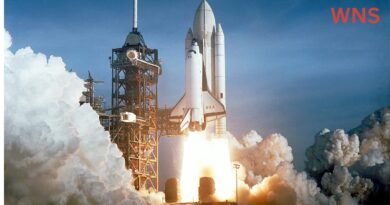
Van Allen Probe A was launched on August 30, 2012, from Cape Canaveral alongside its twin, Van Allen Probe B, as part of NASA’s Radiation Belt Storm Probes mission—later renamed the Van Allen Probes .
The twin spacecraft were designed to fly through Earth’s Van Allen radiation belts, two giant doughnut-shaped zones of charged particles trapped by the planet’s magnetic field . These belts serve as an invisible shield, protecting Earth from destructive solar winds and cosmic radiation .
Originally intended for a two-year mission, the probes operated for nearly seven years, far exceeding their design life . They ceased operations in 2019 after running out of fuel and could no longer orient themselves toward the Sun .
During their operational lifetime, the Van Allen Probes made several fundamental discoveries :
- Third radiation belt: Scientists recorded for the first time the temporary appearance of a third radiation layer during peak solar activity—a phenomenon previously considered impossible .
- Belt dynamics: The probes studied how the radiation belts contract and expand under the pressure of solar storms, providing critical data for protecting satellite electronics .
- Particle acceleration: They helped scientists understand how particles in the belts are accelerated to near-light speeds, solving a decades-old puzzle .
The mission marked a milestone as the first spacecraft designed to operate for extended periods inside the harsh radiation belts—a region most missions usually avoid due to the intense particle environment that can damage electronics .
Safety risk assessment
Despite headlines about a “NASA satellite crash,” experts consistently emphasized that the threat to human life was minimal . The U.S. Space Force estimated the probability of someone being harmed at roughly 1 in 4,200, according to NASA’s website .
Several factors explain the low risk :
- Oceans cover approximately 70 per cent of Earth’s surface
- Many land areas remain sparsely populated
- Most of the spacecraft was expected to burn up during re-entry
For comparison, approximately one object—a rocket body or small satellite—reaches Earth’s surface every week on average, with most falling into oceans or remote areas without making news . Over a 40-year period, scientists estimate that roughly 5,400 tons of material from spacecraft and satellites have survived re-entry .
Dr. Darren McKnight of LeoLabs offered perspective: “We’ve had things that have reentered have a 1 in 1,000 chance, and nothing happened; if we have a few that are 1 in 4,000 or 5,000, it’s not a horrible day for mankind” .
Historically, there has been only one recorded instance of a person being struck by space debris. In 1997, Lottie Williams of Oklahoma was walking in a park when a small piece of metal fell and hit her shoulder. She was unharmed, and NASA believes the object was most likely the remains of a second stage from a Delta rocket .

NASA noted that the probability of a particular individual being hit by space debris is only one in several trillion .
Final moments and legacy
As Van Allen Probe A prepared for its final plunge, astronomers and amateur skywatchers in North America and over the Atlantic had positioned cameras to capture the event, though the daytime re-entry over the Pacific limited viewing opportunities .
The spacecraft’s re-entry marks the end of a mission that NASA described as critical for understanding space weather and its effects on satellites, astronauts, and terrestrial systems like communications, navigation, and power grids . The data collected continues to inform the design of radiation-resistant electronics for missions including NASA’s Artemis program to return humans to the Moon .
“Van Allen Probe A’s legacy endures past its satellite re-entry drama,” the Times of India Science Desk noted. “Their findings have been critical for designing radiation-resistant electronics, aiding space weather forecasts that protect grids and communications” .
The spacecraft’s controlled demise—though uncontrolled in its final descent—also highlights growing concerns about space debris in an era of booming satellite launches. With more than 30,000 tracked objects in orbit and 100 to 400 tonnes of material re-entering annually, experts emphasize the importance of “design for demise” approaches that ensure future spacecraft disintegrate completely during re-entry .
NASA had lowered the probe’s orbit before deactivation in 2019 to facilitate eventual burn-up, complying with international debris mitigation guidelines .
Twin probe still operational
Van Allen Probe B, the twin spacecraft launched alongside Probe A in 2012, remains in orbit and is not expected to re-enter the atmosphere until at least 2030 . It too ceased operations in 2019 after running out of fuel but continues its silent drift through the radiation belts it once studied so productively .
Van Allen Probe A’s uncontrolled re-entry over the Pacific Ocean on March 11, 2026, brought a fitting close to a mission that revolutionized scientific understanding of the radiation environment surrounding Earth. The 600-kilogram spacecraft, originally expected to remain in orbit until 2034, was pulled earthward eight years early by atmospheric drag intensified during an unexpectedly powerful solar maximum.
For NASA and the Space Force teams who tracked its descent, the event represented a routine if carefully monitored re-entry—the kind that occurs weekly somewhere on the planet. For the scientists who built and operated the Van Allen Probes, it marked the final chapter for a spacecraft whose seven years of operational life yielded discoveries that will inform space exploration for decades to come.
As one of thousands of objects to re-enter Earth’s atmosphere this year, Probe A’s fiery demise was unremarkable in the annals of space debris. But as the spacecraft that revealed a third radiation belt and unlocked the dynamics of the invisible shields protecting all life on Earth, its place in scientific history is secure.
Sources / Inputs
NASA: Van Allen Probe A to Re-Enter Atmosphere – Official Statement
The Future of Science & Technology: AI, Space, Biotechnology & Digital Transformation Explained.
iQOO launches Z11x in India with MediaTek Dimensity 7400 Turbo and 50MP Sony sensor, Armed robots transform Ukraine’s battlefield as robot-on-robot clashes emerge.