UN Chief Warns ‘Rule of Force’ Is Dismantling Global Order as Human Rights Come Under Assault
GENEVA, February 23, 2026— The rule of law is being “outmuscled by the rule of force” across the globe, United Nations Secretary-General António Guterres warned on February 23, 2026, delivering a stark assessment of an international order he said is being deliberately dismantled by the world’s most powerful actors.
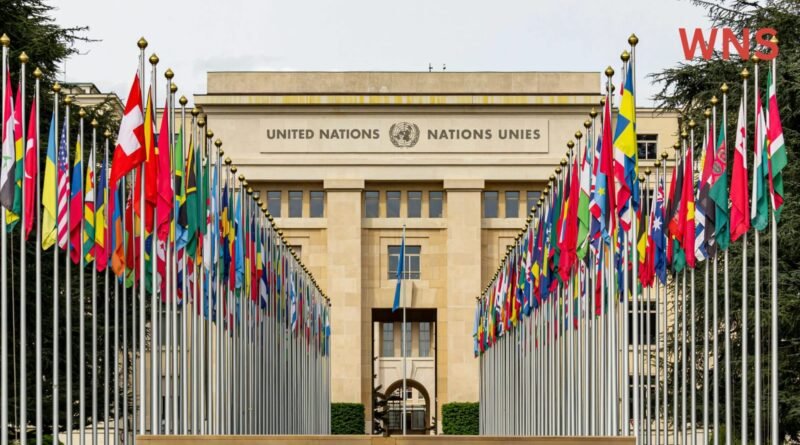
Addressing the opening of the UN Human Rights Council’s 61st annual session at the Palace of Nations, Guterres declared that human rights are “under a full-scale attack around the world” — an assault unfolding not in shadows but “in plain sight, and often led by those who hold the greatest power.”
The speech marked a somber moment for the Council, coming just weeks after the expiration of the New START nuclear treaty and amid multiplying global conflicts spanning Ukraine, Gaza, Sudan, and the Sahel. For Guterres, who will complete his second five-year term at the end of this year, it was also his final in-person address to the UN’s top rights body.
“When human rights fall, everything else tumbles,” Guterres told delegates gathered in the Swiss city. “Peace. Development. Social cohesion. Trust. Solidarity.”
Brown Rice vs White Rice: Which Is Actually Healthier? What Happens to Your Body When You Stop Eating Sugar for 30 Days.
A World Where Law is a ‘Mere Inconvenience’
The Secretary-General painted a sweeping picture of eroding norms, describing a world where “mass suffering is excused away, where humans are used as bargaining chips, where international law is treated as a mere inconvenience.”
He pointed to specific conflicts where violations have become endemic. In Ukraine, more than 15,000 civilians have been killed during four years of Russia’s full-scale invasion, according to UN monitoring figures. “It is more than past time to end the bloodshed,” Guterres said.
Turning to the Middle East, he condemned “blatant violations of human rights, human dignity and international law in the Occupied Palestinian Territory,” warning that “the two-state solution is being stripped away in broad daylight.” The international community, he insisted, “cannot allow it to happen.”
Beyond these high-profile conflicts, Guterres noted that crises in Sudan, the Democratic Republic of the Congo, and the Sahel region remain front and center, with civilians paying the heaviest price. Millions have been displaced across all three theaters, and humanitarian access remains severely constrained.
But the assault on rights, he emphasized, extends far beyond war zones. “Around the world, human rights are being pushed back deliberately, strategically, and sometimes proudly,” he said.
Echoes of Domination and Supremacy
UN High Commissioner for Human Rights Volker Türk amplified Guterres’ warnings, describing a “deeply worrying trend” in which “domination and supremacy are making a comeback.”
“A fierce competition for power, control and resources is playing out on the world stage at a rate and intensity unseen for the past 80 years,” Türk told the Council. “The use of force to resolve disputes between and within countries is becoming normalized.”
Türk lambasted leaders who appear to believe “that they are above the law, and above the UN Charter,” accusing some of weaponizing economic leverage and spreading disinformation “to distract, silence and marginalize.”
The crises of human rights, Guterres warned, do not exist in isolation. They “mirror and magnify every other global fracture.”
He pointed to widening inequality, accelerating climate chaos, and the misuse of advanced technologies — particularly artificial intelligence — which are increasingly deployed “in ways that suppress rights, deepen inequality, and expose marginalized people to new forms of discrimination both online and offline.”
At the same time, humanitarian needs are “exploding while funding collapses,” Guterres said, noting that countries are “drowning in debt and despair.”
The Vulnerable Pushed to the Margins
The Secretary-General catalogued a sweeping array of communities facing intensified persecution. Democracies are eroding, he said. Migrants face harassment and expulsion “with total disregard for their human rights and their humanity.” Refugees are scapegoated. LGBTIQ+ communities are vilified. Minorities, indigenous peoples, and religious communities are targeted.
“Across every front, those who are already vulnerable are being pushed further to the margins,” he said.
Human rights defenders, he added, “are among the first to be silenced when they try to warn us.”
The crisis, Guterres argued, is not due to a lack of knowledge, tools, or institutions. “It is the result of political choices.”
A Three-Pronged Call to Action
To reverse the deterioration, Guterres outlined three urgent fronts for action.
First, he called for an uncompromising defense of shared foundations: the UN Charter, the Universal Declaration of Human Rights, and international human rights law. “Leaders cannot pick the parts they like and ignore the rest,” he said.
Second, he urged strengthening international institutions themselves. He renewed his call for reform of the Security Council — which he said must reflect the world of today, not 1945 — and of the global financial architecture, to ensure developing countries have a real voice and sufficient investment.
“When the Security Council is paralyzed, when vetoes serve as political cover, when geopolitical rivalries trump the protection of civilians, the result is the same,” Guterres said. “Impunity spreads. Suffering multiplies. And human rights are trampled.”
Third, he urged nations to “unlock the power of human rights,” arguing that rights are not an obstacle to progress but essential to it. “Where rights advance, conflict loses ground. Where justice strengthens, violent extremism weakens. Where equality expands, possibility explodes.”
A Final Plea
Drawing on his personal history — growing up under the Salazar dictatorship in Portugal, which taught him that “the denial of human rights corrodes every aspect of society” — Guterres made a final appeal to the Council he has addressed for nearly a decade.
“Do not let the erosion of human rights become the accepted price of political expediency or geopolitical competition,” he urged. “Do not let power write a new rulebook in which the vulnerable have no rights and the powerful have no limits.”
He called on nations to support the pivotal work of the International Court of Justice and the International Criminal Court, to deliver on the Sustainable Development Goals, and to accelerate climate action.
“Let this Human Rights Council be the voice and shield for all those in need,” Guterres said. “Because a world that protects human rights protects itself.”
Reactions and Divisions
The Secretary-General’s remarks drew mixed responses from member states. Western delegations largely applauded his assessment, with the European Union’s ambassador to the UN in Geneva issuing a statement affirming that “human rights must never become a bargaining chip in geopolitical contests.”
China’s representative, however, cautioned against what he termed “selective application of human rights standards,” arguing that development must remain the priority for developing nations. Russia’s delegate dismissed the speech as “ignoring root causes of global instability,” according to diplomatic sources present.
Human rights organizations welcomed Guterres’ frankness. Amnesty International’s UN representative called the address “a necessary alarm bell,” while Human Rights Watch noted that “the challenge now is whether states will act on these words or let them fade into yet another UN record.”
The 61st session of the Human Rights Council continues through early April, with agenda items including country-specific situations in Ukraine, Myanmar, and the Occupied Palestinian Territory, as well as thematic discussions on climate justice and technology’s impact on rights.
with inputs from
RFI: UN chief warns ‘rule of force’ attacking human rights, February 23, 2026 [web:64]
Japan Times: U.N. chief decries global rise of ‘rule of force’, February 23, 2026 [web:65]
France24: UN chief decries global rise of ‘rule of force’, February 23, 2026 [web:66]
Reuters: Human rights under assault globally, says UN Secretary General, February 23, 2026 [web:70]
UN News: Doing what’s right is ‘not a spectator sport’, Human Rights Council told, February 23, 2026 [web:73
Human Rights Systems Explained: Law, Enforcement & Global Justice.
UN Condemns Israel’s Death Penalty Law Targeting Palestinians as ‘Cruel and Discriminatory’, 22 Migrants Die After Drifting Six Days Without Food or Water Off Greek Coast.