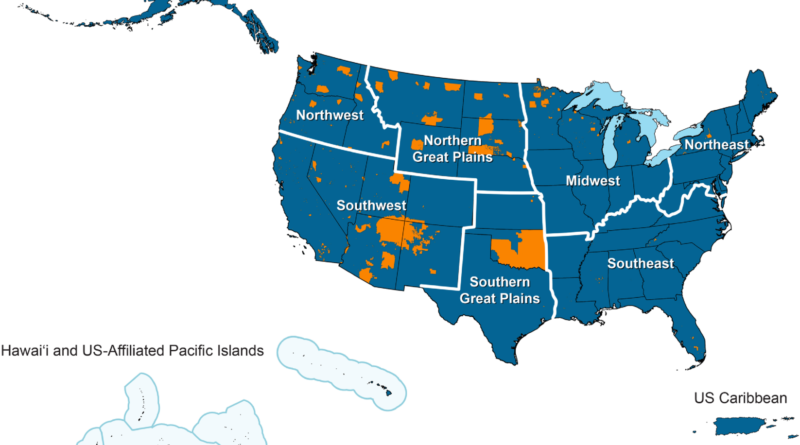
41 U.S. States Are Getting Warmer — But Not All in the Same Way, New Study Finds
WASHINGTON — Climate change is altering temperatures across much of the United States, but the warming is not happening uniformly. A new scientific study examining more than seven decades of temperature data across the country suggests that while average temperatures have risen significantly in many places, an even larger number of states are experiencing warming in specific parts of their temperature ranges.
The research indicates that 41 U.S. states are becoming warmer in at least some parts of their temperature distribution, even if the overall average temperature increase in those states is not statistically significant. The findings suggest that climate change is influencing temperature patterns in ways that vary widely by region.
The study, titled “Regional heterogeneity and warming dominance in the United States,” was published on February 4, 2026 in the open-access scientific journal PLOS Climate. The paper is freely available online at:
https://journals.plos.org/climate/article?id=10.1371/journal.pclm.0000808
Researchers say the findings highlight how regional differences in climate change could shape agriculture, public health, infrastructure planning, and policy decisions across the country.
A Different Way of Measuring Climate Change
Climate change research often focuses on changes in average temperature, a commonly used indicator for tracking global warming trends. However, the authors of the new study argue that averages alone may not fully capture the complexity of how temperatures are changing.
Instead of focusing solely on average values, the researchers examined the entire distribution of temperatures recorded in each state. This approach allowed them to detect changes in specific parts of the temperature range — including the highest temperatures, the lowest temperatures, and other variations within the overall climate pattern.
According to the authors, this method reveals patterns that are not always visible when looking only at average values.
“Looking beyond average temperatures, we show that most U.S. states are warming in specific parts of the temperature distribution, even when average warming is not statistically significant,” the researchers wrote in the study.
The authors also concluded that these differences illustrate “strong regional inequalities in how climate change is experienced across the United States.”
The Study and Its Authors
The research was conducted by María Dolores Gadea Rivas of the University of Zaragoza in Spain and Jesús Gonzalo of Universidad Carlos III de Madrid.
Their study was published in the peer-reviewed journal PLOS Climate, which specializes in climate science research and is part of the Public Library of Science (PLOS), a nonprofit organization that promotes open scientific publishing.
The article can be accessed through the journal at:
https://plos.io/4q9tXwJ
Because the journal operates under an open-access model, the study and its associated materials are freely available to the public.
A Dataset Spanning More Than 70 Years
To analyze temperature trends across the United States, the researchers compiled an extensive dataset covering daily temperature observations from 1950 through 2021.
According to the study, the dataset included more than 26,000 daily temperature observations per state, providing a highly detailed record of temperature patterns across the contiguous United States.
Using statistical techniques, the researchers examined how the distribution of temperatures within each state changed over time. Instead of simply calculating an overall average, they analyzed how different parts of the temperature range shifted over the decades.
This allowed them to identify whether changes were occurring primarily in extreme heat events, cold extremes, or other segments of the temperature spectrum.
The analysis covered all 48 contiguous U.S. states, offering one of the most comprehensive comparisons of regional temperature distributions in the country.
Average Temperatures vs. Temperature Extremes
When the researchers examined average temperatures alone, they found statistically significant warming in 27 states, or about 55 percent of the country.
However, when they looked at the full distribution of temperatures, the picture changed dramatically.
The study found that 41 states — about 84 percent of the contiguous United States — experienced warming in at least one part of their temperature distribution.
This means that even states where the average temperature increase was not statistically significant may still be experiencing important climate shifts.
For example, a state might show little change in its average temperature but still experience warmer summers, milder winters, or more frequent extreme heat events.
These types of changes can have meaningful impacts on ecosystems, agriculture, and human health even if the overall average appears relatively stable.
Regional Differences in Warming Patterns
The research also revealed significant regional variation in how warming is occurring across the United States.
According to the study, states along the West Coast have experienced increases primarily in their highest annual temperatures. In these regions, the hottest days of the year are becoming hotter.
Meanwhile, many northern states are seeing increases in their lowest temperatures, indicating that winters may be becoming milder and extreme cold events less frequent.
These regional differences mean that climate change may manifest in different ways depending on geography and local environmental conditions.
Such variations can be influenced by factors including atmospheric circulation patterns, ocean currents, land-use changes, and regional weather systems.
The authors say these differences highlight the importance of examining climate change at regional and local scales, rather than relying solely on national or global averages.
Potential Impacts on Agriculture
Changes in temperature extremes can have major consequences for agriculture.
In regions where maximum temperatures are increasing, crops may face greater heat stress, which can reduce yields or require changes in planting schedules and irrigation practices.
Higher temperatures can also increase evaporation from soil and water sources, potentially putting pressure on water supplies in agricultural regions.
In contrast, areas experiencing warmer minimum temperatures may see longer growing seasons. While this could benefit some crops, it may also lead to shifts in pest populations, plant diseases, and ecological balances.
According to the study, these varying climate effects suggest that agricultural adaptation strategies may need to be tailored to specific regions rather than applied uniformly across the country.
Implications for Public Health
Temperature changes can also influence human health outcomes.
Rising extreme temperatures are associated with increased risks of heat-related illnesses, particularly during heat waves. Older adults, outdoor workers, and people without access to air conditioning are often among the most vulnerable populations.
Higher nighttime temperatures can also pose health risks. When temperatures remain elevated overnight, the human body has less opportunity to recover from daytime heat exposure.
Conversely, warmer winter temperatures could reduce certain cold-related health risks in some regions.
However, the overall impact of temperature changes on public health varies depending on factors such as local infrastructure, urban design, and access to healthcare.
The study notes that understanding regional climate patterns can help public health officials prepare for potential risks associated with changing temperature conditions.
Climate Change and Public Perception
The authors also note that regional differences in climate impacts may influence how people perceive climate change.
Communities experiencing frequent extreme heat events may perceive climate change as an immediate and visible issue. In contrast, regions where warming is more subtle or concentrated in winter temperatures may experience climate change differently.
These variations in experience could influence public attitudes toward climate policies and mitigation strategies.
The researchers suggest that recognizing these differences may help policymakers and communicators better explain climate risks to local communities.
A Framework for Studying Climate Variability
Beyond its findings about U.S. temperature trends, the study also introduces a statistical framework that could be used to examine other climate variables.
The researchers say the same analytical method could be applied to study changes in precipitation patterns, drought frequency, sea-level rise, and other climate-related phenomena.
By analyzing entire distributions rather than averages alone, scientists may gain a more detailed understanding of how climate conditions are evolving.
Such methods may also help identify emerging climate risks that could otherwise remain hidden within broader averages.
Climate Change as a Global Issue With Local Consequences
While climate change is a global phenomenon driven largely by greenhouse gas emissions, its impacts often manifest differently depending on location.
Geography, regional weather patterns, land-use changes, and local environmental conditions all influence how climate change affects specific areas.
As a result, climate adaptation strategies may need to be tailored to regional circumstances.
For example, regions experiencing increasing heat extremes may focus on improving heat-resilient infrastructure, expanding cooling centers, and strengthening electricity grids to handle higher air-conditioning demand.
Areas experiencing milder winters may instead focus on water management, ecological changes, or shifts in agricultural practices.
The study suggests that understanding regional differences in climate change can help policymakers design more targeted and effective responses.
Future Research Directions
The authors say further research will be needed to explore how changes in temperature distributions interact with other environmental factors.
Future studies could investigate how regional warming patterns influence wildfire activity, drought cycles, precipitation variability, and ecosystem shifts.
Researchers may also explore how these climate changes affect economic sectors such as agriculture, energy production, and tourism.
Better understanding these connections could help governments and communities plan for long-term climate risks.
Funding and Declarations
According to the journal, the research received funding from several institutions, including the Government of Aragón and the European Regional Development Fund, as well as grants from Spain’s national research agency.
The study states that the funders had no role in study design, data collection, analysis, decision to publish, or preparation of the manuscript.
The authors also declared that no competing interests exist.
Study Citation
Gadea Rivas MDG, Gonzalo J (2026).
Regional heterogeneity and warming dominance in the United States.
PLOS Climate 5(2): e0000808.
https://doi.org/10.1371/journal.pclm.0000808
High-resolution image provided by PLOS:
https://plos.io/4qNRLaz
About PLOS Climate
PLOS Climate is a peer-reviewed scientific journal published by the nonprofit organization PLOS. The journal focuses on research related to climate change and its impacts on society and the environment.
PLOS journals operate under a Creative Commons Attribution license, which allows the reuse of published material as long as the original work is properly cited.
More information about the journal can be found at:
https://journals.plos.org/climate
Climate Change Explained: Science, Global Policy, Economic Impact & Sustainability Strategy.
Probe Underway After 72 Tigers Die from Virus at Thai Tourist Park, Officials Rule Out Bird Flu and Climate Change Explained: Science, Global Policy, Economic Impact & Sustainability Strategy.